Inflammaging: How Chronic Inflammation Accelerates Aging (And What You Can Do)
Introduction: Why Aging Is Not Just About Time
Most people think aging is simply the passage of years. In reality, aging is driven by biological processes happening inside the body, long before wrinkles or gray hair appear. One of the most important—and least understood—of these processes is chronic inflammation.
Scientists now use the term “inflammaging” to describe the slow, persistent inflammation that develops as we age. Unlike acute inflammation, which helps heal injuries or fight infections, inflammaging quietly damages tissues over time and plays a major role in nearly every age-related condition.
At Innovations Stem Cell Center, we focus on understanding and addressing inflammaging at its source—the immune system and cellular communication networks that regulate inflammation. This article explains what inflammaging is, why it matters, and how emerging regenerative strategies may help support healthier aging.
What Is Inflammaging?
Inflammaging is a term coined by researchers to describe chronic, low-grade inflammation associated with aging. Unlike short-term inflammation caused by injury or illness, inflammaging:
Persists for years or decades
Often occurs without obvious symptoms
Gradually damages tissues and organs
Disrupts normal immune regulation
Research shows that as we age, the immune system becomes less precise. It may remain slightly activated even when no real threat exists, leading to ongoing inflammatory signaling throughout the body.
👉 Learn more about immune regulation here:
https://www.innovationsstemcellcenter.com/stem-cells/what-is-the-best-way-to-reduce-inflammation
Why Chronic Inflammation Accelerates Aging
1. Cellular Damage
Inflammatory molecules such as cytokines and reactive oxygen species damage:
DNA
Cell membranes
Mitochondria (the cell’s energy producers)
Over time, this damage reduces cellular efficiency and resilience.
2. Stem Cell Exhaustion
Chronic inflammation disrupts the environment that stem cells need to function properly. This leads to:
Reduced tissue repair
Slower healing
Degeneration of joints, muscles, and organs
3. Immune System Imbalance
Aging immune systems often become:
Overactive in some pathways
Underactive in others
This imbalance increases susceptibility to infections while promoting autoimmune and inflammatory conditions.
4. Accumulation of Senescent Cells
Inflammation promotes the buildup of senescent cells—damaged cells that no longer function normally but continue releasing inflammatory signals, further fueling inflammaging.
Diseases Linked to Inflammaging
Inflammaging is now recognized as a contributing factor in many age-related conditions, including:
Cardiovascular disease
Type 2 diabetes
Arthritis and joint degeneration
Neurodegenerative disorders (Alzheimer’s, Parkinson’s)
Frailty and muscle loss (sarcopenia)
Autoimmune conditions
According to research published in Frontiers in Immunology and Nature Reviews Immunology, chronic inflammation is a shared underlying mechanism behind many of these diseases.
What Causes Inflammaging?
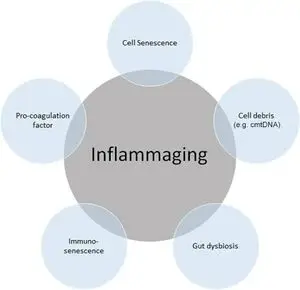
Inflammaging does not come from a single source. It is driven by multiple overlapping factors:
1. Aging Immune Cells
As immune cells age, they lose the ability to shut down inflammatory responses efficiently.
2. Cellular Debris and Damage
Damaged cells release signals that trigger inflammation, even in the absence of infection.
3. Metabolic Dysfunction
Obesity, insulin resistance, and poor metabolic health all increase inflammatory signaling.
4. Gut Barrier Breakdown
Aging weakens the gut lining, allowing inflammatory molecules to enter circulation.
5. Environmental Stressors
Poor sleep, chronic stress, pollution, and sedentary lifestyle all contribute to long-term inflammation.
Inflammaging vs. Normal Inflammation
| Normal Inflammation | Inflammaging |
|---|---|
| Short-term | Long-term |
| Triggered by injury or infection | Often no clear trigger |
| Resolves after healing | Persists for years |
| Protective | Degenerative |
Understanding this difference is critical. The goal is not to eliminate inflammation, but to restore proper immune balance.
The Role of the Immune System in Healthy Aging
Healthy aging depends on an immune system that can:
Respond quickly to real threats
Shut down inflammation once the threat is gone
Avoid attacking healthy tissues
As we age, this balance becomes harder to maintain.
At Innovations Stem Cell Center, our regenerative focus emphasizes immune modulation, not immune suppression.
How Stem Cells Interact With Inflammation (What Research Shows)
Mesenchymal stem cells (MSCs), including those derived from adipose (fat) tissue, play a unique role in regulating inflammation.
Research published in Frontiers in Aging and Biogerontology shows that MSCs:
Release anti-inflammatory signaling molecules
Help calm overactive immune cells
Promote tissue repair without triggering immune attack
Improve the environment surrounding damaged or aging cells
Importantly, MSCs do not simply suppress inflammation. They help guide the immune system back toward balance.
PubMed reference:
https://pubmed.ncbi.nlm.nih.gov/32709406/
Why Adipose-Derived Stem Cells Matter
Adipose tissue is one of the richest sources of adult mesenchymal stem cells. Compared to other sources, adipose-derived stem cells:
Are abundant and easily obtained
Maintain potency with age
Are well-suited for immune modulation
Come from the patient’s own body (autologous)
Inflammaging and Healthspan
Healthspan refers to how well you live as you age—not just how long you live.
Reducing inflammaging may help:
Preserve mobility and strength
Support cognitive clarity
Improve metabolic health
Reduce frailty
Enhance quality of life
Lifestyle Still Matters
Regenerative medicine works best when combined with healthy habits. Research consistently shows that inflammaging is influenced by:
Nutrition (whole foods, low processed sugars)
Physical activity
Sleep quality
Stress management
Weight control
Stem cell–based approaches are not replacements for lifestyle—but they may support the body’s ability to respond more effectively.
What Inflammaging Research Does NOT Claim
Responsible science does not claim that:
Inflammaging can be completely eliminated
Aging can be stopped
One treatment works for everyone
Instead, research supports a more realistic goal: supporting immune balance and reducing unnecessary inflammatory stress.
Why Innovations Stem Cell Center Focuses on Immune Balance
At Innovations Stem Cell Center, our approach emphasizes:
Autologous adipose-derived stem cells
Immune system regulation
Whole-body, systems-based care
Science-aligned regenerative medicine
We believe aging should be addressed upstream, before chronic inflammation becomes irreversible disease.
👉 Learn about our process:
https://www.innovationsstemcellcenter.com/our-stem-cell-process
Key Scientific References (PubMed)
Franceschi C, Campisi J. Chronic Inflammation (Inflammaging) and Its Potential Contribution to Age-Associated Diseases. J Gerontol A Biol Sci Med Sci. 2014. https://pubmed.ncbi.nlm.nih.gov/24833586/
- Franceschi C, et al. Inflammaging and anti-inflammaging: a systemic perspective on aging and longevity emerged from studies in humans. Mech Ageing Dev. 2007. https://pubmed.ncbi.nlm.nih.gov/17116321/
Fulop T, et al. Immunosenescence and inflammaging.
https://pubmed.ncbi.nlm.nih.gov/30018187/Galipeau J, Sensébé L. Mesenchymal Stem Cell Immunomodulation: Mechanisms and Therapeutic Potential. Trends Pharmacol Sci. 2020.
https://pubmed.ncbi.nlm.nih.gov/32709406/
Final Takeaway
Inflammaging is one of the most powerful drivers of biological aging—but it is not inevitable. By understanding how chronic inflammation affects the immune system and cellular repair, new regenerative strategies may help support healthier aging.
Rather than chasing youth, the goal is resilience, balance, and function—and addressing inflammaging is a critical step in that journey.