
“MSC therapy” can mean very different products: your own fresh cells, donor birth-tissue products, lab-grown cells, or exosomes, which are not cells at all. Knowing which one you are being offered matters more than the label.
At our Dallas clinic, we use your own fat-derived (adipose) MSCs: typically 100 million cells or even more (counts may vary), tested for count and viability, and used the same day. They are never frozen.
New Patient Inquiries (Call or Text), Mon–Fri 8:30 AM–5 PM. Stem cell therapy is not FDA-approved for these uses and is not covered by insurance. Individual results vary.
Mesenchymal stem cells, also called mesenchymal stromal cells, are a type of adult cell found in connective tissues throughout the body. The International Society for Cellular Therapy describes them by three lab features: they stick to plastic in culture, they carry a specific set of surface markers, and they can develop into bone, cartilage and fat cells.[1]
Researchers are most interested in what MSCs signal. MSCs release growth factors and other messengers that can influence inflammation and the immune response around them. That signaling, more than turning into new tissue, is the main focus of current research.[4]
Fat (adipose) tissue is one of the richest and most accessible sources of these cells in adults.[3] Adipose-derived cells meet the same core definition as MSCs from other tissues.[2]
Clinics use the words “stem cells” and “MSCs” for products that have little in common. Some contain your own living cells. Some come from a donor and are frozen and shipped. Some have been found in lab studies to contain few or no living cells, and exosomes are not cells at all. Here is how the main types compare.
| Type | Whose cells? | Living cells? | How it is made | Fresh or frozen? | FDA status |
|---|---|---|---|---|---|
| Your own fat (adipose), same day What we use | Yours (autologous) | Yes. At our clinic, each patient’s cells are tested for count and viability | A small liposuction under local anesthesia; cells prepared in our office | Used the same day, never frozen | Not FDA-approved for the conditions we treat |
| Your own bone marrow | Yours (autologous) | Yes, though bone marrow holds fewer MSCs per sample than fat[3] | A needle aspiration, usually from the hip bone, then concentrated | Usually used the same day | Not FDA-approved for orthopedic or other chronic conditions |
| Umbilical cord or Wharton’s jelly | A donor’s (allogeneic) | Varies by product and processing; ask for testing results | Donated birth tissue processed by an outside lab | Usually frozen for storage and shipping | Not FDA-approved; the FDA has warned consumers about unapproved cord products[8] |
| Amniotic and placental products | A donor’s (allogeneic) | Lab studies of commercial products found few or no living cells[11][12] | Donated amniotic fluid or membrane collected after birth | Usually frozen or dried | Not FDA-approved for these uses[8] |
| Lab-grown (culture-expanded) MSCs | Yours or a donor’s | Yes, multiplied in a lab | Cells grown in a lab for weeks to reach larger numbers | Usually frozen before use | Not FDA-approved for orthopedic or other chronic conditions; one donor bone marrow product is approved for a rare transplant complication in children[9] |
| Exosomes | Made from donor or lab-grown cells | No. Exosomes are tiny particles released by cells; they cannot divide or grow[13] | Collected from fluid around cells grown in a lab | Usually frozen or freeze-dried | Not FDA-approved; the FDA has warned consumers about exosome products[8] |
Same-day treatment uses the cells collected from you that day. Lab-grown products multiply cells over weeks, which raises the cell count but usually means freezing, storage and shipping before use. The only FDA-approved MSC product, made from donor bone marrow, is approved for one rare condition in children.[9]
Researchers who tested commercial amniotic fluid products could not identify MSCs, and most cells present were dead.[11] A study of nine amnion, chorion, umbilical cord and amniotic fluid products found no live cells in any of them.[12] These products may still contain proteins and growth factors.
Exosomes and other extracellular vesicles are particles released by cells. They carry proteins and genetic material, but they have no nucleus and cannot copy themselves.[13] We do not offer exosomes. For a side-by-side, read PRP vs. stem cells vs. exosomes.
Research has not shown that one source gives better results in patients.[4] We chose your own fat because it is a rich source of MSCs that can be collected and used fresh the same day.[3] Age can affect how these cells grow, which is one reason we test each patient’s cells.[7] Read the full adipose vs. umbilical cord comparison.
We use your own cells. The exception is our autism program for patients 15 and older, where a parent’s donated cells may be used in some cases.
Whatever clinic you consider, these questions help you understand what you would actually receive.
Curious what treatment day involves? The step-by-step is on our how stem cell therapy works page.
MSC therapy is an active research field. Here is a fair summary of where the evidence stands, including what is still unknown.
A 2020 systematic review of clinical trials found that MSCs given into a vein continued to appear safe. Short-lived fever was more common, and no link was found to serious problems such as infection or cancer.[5] Every procedure still has risks, which we review with you.
A small randomized trial in 30 people with knee osteoarthritis reported less pain and better function at 12 months after adipose-derived MSC injections, compared with usual care.[6] Larger, longer trials are still needed.
Researchers once thought donor MSCs were “immune privileged.” Later work showed the immune system can recognize donor MSCs over time.[4] Using your own cells avoids that question.
The ideal cell dose, number of treatments and who is most likely to respond are still being studied. No one can promise an outcome from MSC therapy. Individual results vary.
Patients most often ask about MSC therapy for joint and orthopedic pain. We also evaluate patients with certain autoimmune, neurologic and lung conditions. Dr. Johnson reviews your history to decide whether treatment is a reasonable fit, and he will tell you if it is not.
To see what we look for, read who may qualify for stem cell therapy.
Not for the conditions we treat. In December 2024, the FDA approved the first mesenchymal stromal cell product, made from donor bone marrow, for children with steroid-refractory acute graft-versus-host disease.[9] No MSC product is FDA-approved for orthopedic, neurologic, autoimmune or lung conditions.
The FDA has warned consumers about unapproved regenerative products, including those made from fat, umbilical cord and other birth tissues.[8] Our treatment is not FDA-approved for these uses. Our protocols are reviewed by an IRB (Institutional Review Board).
The FDA encourages patients to ask questions and understand the risks before any regenerative treatment.[10] We welcome those questions.









Dr. Johnson has been featured on TV for 20+ years. To hear from patients in their own words, watch our patient stories.
Patient experiences are individual. Individual results vary.
Our team can talk through candidacy, travel and pricing by phone or text.
Innovations Stem Cell Center was named a “Top Stem Cell Therapy Treatments Company” by Life Sciences Review in 2025 and again in 2026.
An award reflects the publication’s editorial review. It is not a prediction of any individual patient’s outcome.
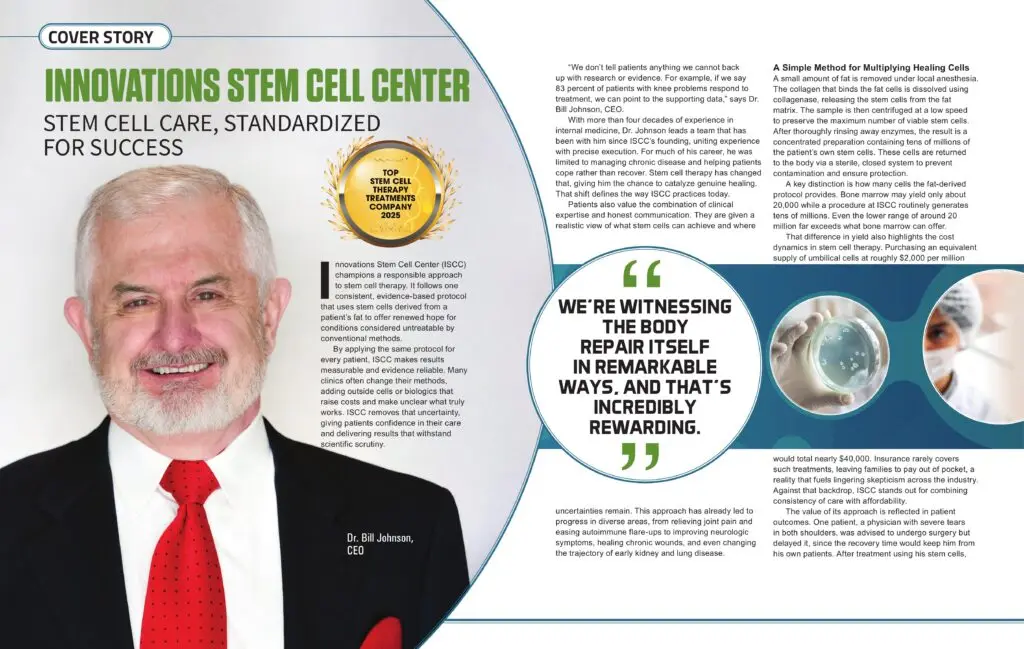
We publish our prices so you can plan before your consultation.
Consultations are free, with no hidden or facility fees. Financing is available. Insurance does not cover the treatment itself, though LabCorp lab work can be billed to your insurance. Out-of-town patients receive a complimentary hotel stay for themselves and a companion.
Mesenchymal stem cell therapy uses MSCs, adult cells that can develop into bone, cartilage and fat cells and that release signals involved in inflammation and healing. At our Dallas clinic, we use your own fat-derived MSCs, collected and given the same day. Stem cell therapy is not FDA-approved for these uses. Individual results vary.
We use your own cells, taken from a small amount of your fat under local anesthesia. The exception is our autism program for patients 15 and older, where a parent’s donated cells may be used in some cases.
We typically get 100 million cells or even more (counts may vary). We run a count and viability test on each patient’s cells before treatment, and they are used the same day without freezing.
Research has not shown that either source gives better results in patients. Cord cells come from a donor and are usually frozen; fat-derived cells come from you and, at our clinic, are used fresh. Our page on adipose vs. umbilical cord cells covers the details.
It depends on the product, so ask for testing results. Lab studies of commercial amniotic fluid and other birth-tissue products found few or no living cells, and none of these products is FDA-approved for orthopedic or other chronic conditions.
Same-day treatment uses cells collected from you and returned in one visit. Lab-grown, or culture-expanded, MSCs are multiplied in a lab over weeks and are usually frozen before use. At our clinic, your cells are used the same day and never frozen.
No. Exosomes are tiny particles released by cells. They carry proteins and genetic material but are not cells and cannot divide. Exosome products are not FDA-approved, and we do not offer them.
Not for the conditions we treat. The FDA approved one donor bone marrow MSC product in December 2024 for a rare complication of transplants in children. Our treatment is not FDA-approved for these uses, and our protocols are reviewed by an IRB.
Common effects include bruising and soreness where fat is collected or cells are injected. As with any procedure, there is a small chance of infection, and symptoms may not improve. Dr. Johnson reviews the risks, benefits and alternatives with you before treatment.
Joint treatment is a flat $16,500 for the joints that need treatment plus the IV dose, with acoustic wave therapy included. Other conditions start at $16,500 with the IV dose, spine treatment is $19,000, and a second treatment, if needed, is $10,000. Consultations are free.
Start with a free consultation. We review your history, imaging and goals and tell you honestly whether treatment is a reasonable fit. Call or text New Patient Inquiries at (972) 893-9849, Monday to Friday, 8:30 AM to 5 PM.
Tell us about your condition and your goals. We’ll explain the options honestly and let you know whether you may be a candidate. Not sure yet? See who may qualify.
Stem cell therapy is not FDA-approved for these uses. This page is for general information and is not medical advice. Individual results vary. Medically reviewed by Dr. Bill Johnson, October 2026.