
PRP for Hearing Loss & Tinnitus
A new option to explore when hearing changes or ringing in your ears affect everyday life.
Conversations become harder to follow. Background noise takes over. Ringing interrupts quiet moments. At Innovations Stem Cell Center, we now offer an intratympanic platelet-rich plasma (PRP) procedure for selected patients with hearing loss and tinnitus.
Our program uses PRP prepared from your own blood and placed into the middle ear in a series of six weekly treatments. Your evaluation helps determine whether this emerging approach is appropriate for you.
Intratympanic PRP for hearing loss and tinnitus is investigational. Early studies are encouraging, but benefit is uncertain and improvement is not guaranteed.
What is intratympanic PRP?
Platelet-rich plasma is a concentration of platelets obtained from a sample of your own blood. Platelets release growth factors and other signals involved in the body’s repair response. Researchers are studying whether these signals may support injured structures involved in hearing.
Intratympanic, also called transtympanic, means that the PRP is placed through the eardrum into the middle ear. This positions the preparation near the round window, one of the interfaces between the middle and inner ear. The needle is not placed into the cochlea.
This program uses PRP. It does not involve a stem-cell injection or a fat-harvesting procedure.
What to expect from treatment
The procedure is offered under the care of Dr. Bill Johnson at Innovations Stem Cell Center in Dallas. Your care begins with a review of your diagnosis, hearing tests, symptoms, and previous treatments.
Why add calcium chloride?
A small amount of calcium chloride is added to activate the PRP and encourage formation of a fibrin gel. The aim is to make the preparation less free-flowing so it remains near the treatment area longer rather than draining as readily when you change position.
This is a delivery strategy; it does not guarantee retention or a better hearing outcome.
Evaluation and baseline testing
We review your audiogram and medical history, including when the hearing loss or tinnitus began. Additional ENT evaluation or testing may be needed before treatment.
PRP preparation and placement
A blood sample is processed to prepare your PRP. A specialized ear speculum and a fine 27-gauge needle are used to place the preparation through the eardrum into the middle ear.
One procedure each week
The planned course consists of six procedures over six weeks. Your physician provides individualized instructions for preparation, comfort, positioning, and aftercare.
Follow-up after the series
Repeat hearing testing and symptom assessments help determine whether there has been a meaningful change. Finishing the six-week series does not establish the final outcome.
What does the evidence show?
Published human studies have reported hearing improvements after intratympanic PRP. Some have also reported tinnitus relief. These findings justify further research, but studies differ in preparation, patient selection, treatment schedule, and follow-up.
Patients with age-related hearing loss reported as improved
In a 150-patient study covering several types of sensorineural hearing loss, the authors reported hearing improvement in 42 of 58 patients with presbycusis, or age-related hearing loss (72.4%).[1]
Patients received four injections one week apart. All received PRP; no untreated or placebo group is described in the abstract. This is not a success rate for our six-treatment program and does not establish a tinnitus benefit.
Patients reported subjective tinnitus improvement
A preliminary study of 56 patients with sudden sensorineural hearing loss reported subjective tinnitus improvement in 8 of the 17 patients who had tinnitus.[2]
The study used two PRP injections ten days apart, assessed hearing at one month, and had no comparison group. The small tinnitus subgroup cannot predict an individual patient’s response or establish benefit for tinnitus alone.
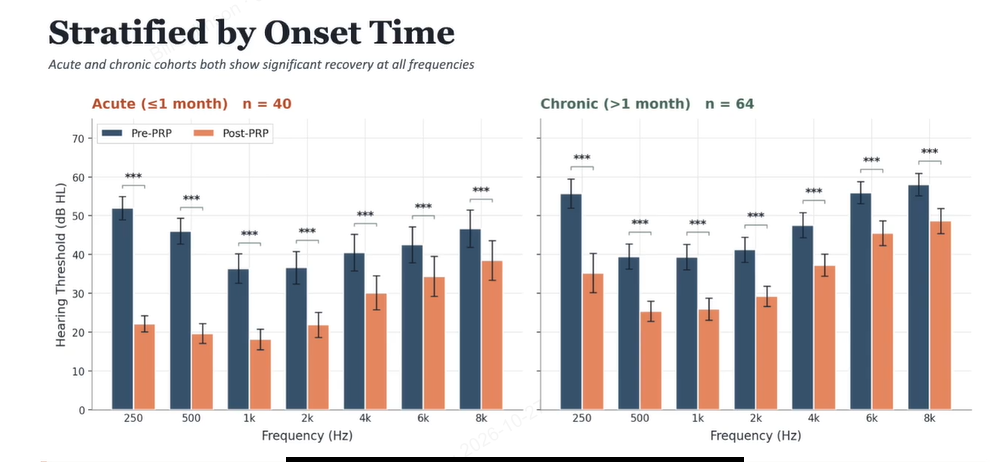
Before and after PRP: recent and longer-standing hearing loss
Lower bars mean better hearing: a lower hearing threshold means a person can detect a quieter sound. The blue bars show hearing thresholds before PRP; the orange bars show thresholds after PRP.
A developing field, with important unanswered questions
Another 2026 study reported improvement in tinnitus questionnaire scores after PRP combined with a steroid. Because it used both treatments, it cannot isolate the benefit of PRP alone.[3]
We do not promise normal hearing, disappearance of tinnitus, or regeneration of human cochlear hair cells. The amount, timing, and durability of any benefit remain uncertain. Hearing aids, audiologic rehabilitation, and established tinnitus care may remain useful.
The delivery approach draws on work developed by South Korean ENT physician Dr. Minbo Shim. His protocol experience and educational presentations are distinct from independent controlled clinical evidence.[4]
Who may be considered?
A consultation may be appropriate if you have documented sensorineural hearing loss, persistent tinnitus, or both, and want to discuss an investigational treatment after reviewing established options.
- Age-related or noise-related sensorineural hearing loss
- Persistent hearing loss after appropriate evaluation and standard care
- Tinnitus associated with hearing loss, with separate assessment of tinnitus symptoms
Not every type of hearing loss is a candidate. Earwax, infection, middle-ear fluid, eardrum problems, and other causes may require different treatment. An audiogram and appropriate medical evaluation come first.
PRP hearing treatment: common questions
Is this a proven cure for hearing loss or tinnitus?
No. Intratympanic PRP is an investigational approach. Preliminary clinical reports suggest possible benefit, but larger controlled studies are needed. Some patients may experience no improvement.
Is PRP the same as stem cell therapy?
No. PRP is prepared from your blood and concentrates platelets. It is different from MSC (mesenchymal stem cell) therapy. This page describes our PRP procedure.
Will it help if I have had hearing loss for years?
Studies have included some patients with chronic hearing loss, including age-related hearing loss. However, there is no reliable way to predict your benefit from duration alone. The cause, severity, hearing-test findings, and overall ear health matter.
When would I notice a change?
There is no established timetable. Studies have used different follow-up periods, and some patients do not improve. We assess symptoms and hearing over time rather than promise immediate improvement or continued recovery for years.
What are the risks?
Blood collection can cause bruising or discomfort. Intratympanic procedures can cause ear pain, pressure, transient dizziness, infection, a persistent opening in the eardrum, or a change in hearing or tinnitus. Much of the procedural safety literature concerns steroid injections; the safety profile of calcium-activated PRP is less established. Your physician will review risks and alternatives before consent.[6]
Should I stop using hearing aids or my other treatments?
Continue your current care unless your treating clinician advises otherwise. PRP does not replace a hearing evaluation, hearing aids, cochlear implant assessment when indicated, or appropriate tinnitus management.
What does the program cost, and is it covered by insurance?
Contact our team for current pricing and payment options. Coverage varies, and an investigational treatment may not be covered. Confirm your benefits and the full course cost before starting.
Let’s talk about your hearing.
Bring your most recent hearing test and your questions. We’ll discuss your history, the available evidence, and whether this PRP program is a reasonable option for you.
Call or text (972) 893-9849
Selected sources
- Shawky MA, Shawky AA, Zakaria NZ. Role of platelet-rich plasma in management of sensorineural hearing loss diseases. Vestn Otorinolaringol. 2026;91(1):4–10. PubMed abstract.
- Sharma S, et al. Intratympanic Platelet-Rich Plasma Therapy for Sudden Sensorineural Hearing Loss: A Preliminary Prospective Study. Indian J Otolaryngol Head Neck Surg. 2024;76:5334–5339. Study abstract.
- Iftikhar M, et al. Therapeutic Role of Intratympanic Platelet Rich Plasma with Steroid in Sensorineural Hearing Loss and Tinnitus. Pak Armed Forces Med J. 2026;76(SUPPL-3):S499–S503. Study.
- Talala.net: Dr. Minbo Shim. Protocol-developer information; not independent efficacy evidence.
- National Institute on Deafness and Other Communication Disorders. Sudden Deafness.
- Assessment of complications due to intratympanic injections. Steroid-injection safety study; not a PRP safety trial.